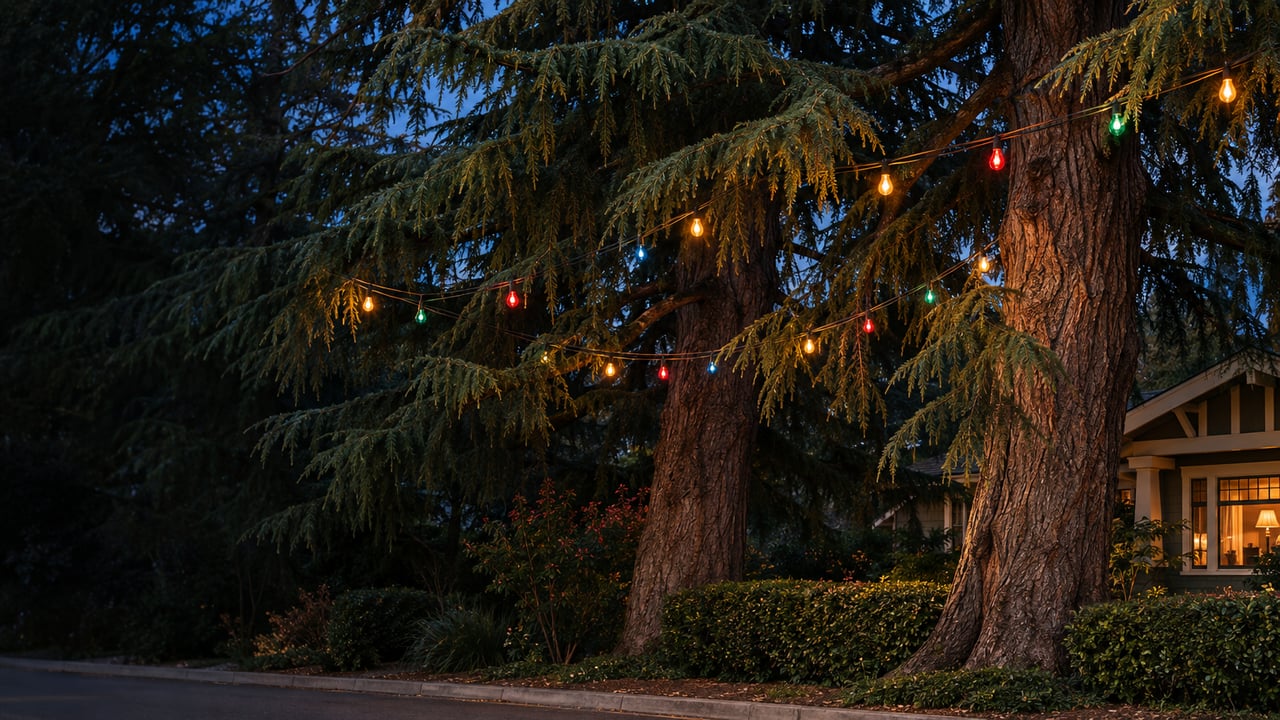
Drive up Santa Rosa Avenue in late summer and the deodars look like they always do, tall and dark green with nothing hanging from them. Every light in those trees came down months earlier. Volunteers rolled each strand onto a hand-powered machine, numbered it and packed it away with the ladders, poles and the association's truck, and they have to put all of it back up before anyone can flip the switch.
That switch flips on Saturday, December 5, at 6 p.m. at the corner of Santa Rosa Avenue and Mariposa Street. It will be the 106th lighting of the stretch of trees Altadena has been lighting since 1920. Last year the volunteers didn't just rehang the old lines. They had to rewire the display by hand because the previous equipment was wrecked, and this year's lighting comes out of the same volunteer cycle that pulled that off.
A display that starts from zero every fall
The Lane runs nearly a mile on Santa Rosa Avenue between Woodbury Avenue and Altadena Drive. The Christmas Tree Lane Association calls it the oldest large-scale outdoor Christmas lighting display in the United States. It holds two formal designations: it is a California State Historic Landmark, and it has been on the National Register of Historic Places since 1990.
Those designations protect the trees. The lights are a separate matter. Colorado Boulevard.net reported that the lights come down every year because sunlight damages them and the trees keep growing, and it described the yearly routine like this:
- Teardown. Strands are sorted and rolled onto hand-powered machines built for the job. Every tree and every string gets a number so it goes back in the same place next season.
- Storage. The lights are stored with the ladders, poles, tables, safety gear and the organization's truck.
- Repair. When the season comes back around, volunteers unroll each string, tighten the sockets, replace bad bulbs and test every line.
- Install. Volunteers hoist the lines into the deodars with ropes and pulleys, working block by block. The install covers more than 4½ miles of wiring.
The bulbs are now energy-efficient LEDs. They are lighter and more durable than the old ones but can still be damaged by UV. The work is not cheap either. The San Gabriel Valley Tribune notes that the volunteer nonprofit strings the lights, maintains the trees and pays the utility and organizing costs.
Volunteers have carried the tradition for a long time. It started in 1920, when a local department store owner organized a tree lighting to bring in shoppers. The association was formed after Altadena voters rejected annexation into Pasadena in 1956 and Pasadena ended its involvement.
The fire caught the lights still in the trees
That yearly cycle explains why January 2025 hit the Lane so hard. The Pasadena Star-News reported that the Eaton Fire started around the time volunteers usually take the previous season's lights down. The equipment was still up in the trees.
None of the 153 deodars was lost. Pasadena Now reported that the damage to branches and lights came from the fierce winds behind the fire, not from embers. The equipment was in worse shape. Spectrum News reported that the association lost all of it, most of it to wind. These are not lights you can pick up at a hardware store. The wiring is done by hand, and every bulb is screwed into its socket one at a time.
Even taking the damaged lines down was unusual work. LAist reported that the Los Angeles County Department of Public Health gave volunteers hazmat suits for the removal in mid-spring.
How 2025 got rebuilt
The rebuild was paid for with outside money and done with local labor. Pasadena Now reported that The Walt Disney Company funded materials, hosted volunteers at its studios twice to build light lines, and donated more than 1,000 toys for the 2025 event. The California Community Foundation also listed a grant to the Rotary Club of Altadena that supports the Lane, whose electrical equipment needed replacement and repair.
Turnout was strong. Volunteer coordinator Mikayla Arevalo had worried the crew would be short because so many residents had been displaced. Spectrum reported that almost 200 people offered to help, which was more than in earlier years, and they rewired the display over ten weekends. Association president Scott Wardlaw told Spectrum News:
"The thing that really impresses me is the willingness of volunteers to come out every year just for the love of it."
In the same interview he said that taking the decorations down takes another eight weekends.
The rebuild also changed how the Lane looks. The replacement lights added more colors than earlier years. One tree was different: the memorial tree is lit in white, except for 19 green bulbs for the 19 people who died in the fire. At the December 6, 2025 ceremony, the crowd kept a minute and 19 seconds of silence before the Lane lit up. Altadena Now covered that night, which included remarks from Rep. Judy Chu, Assemblymember John Harabedian and County Supervisor Kathryn Barger, with Edward James Olmos as emcee.
The 106th lighting relies on the same thing as the 105th: volunteer weekends spent stringing, testing and hoisting lines into numbered trees before the switch can flip.
December 5, hour by hour
The association has scheduled the day around the Santa Rosa and Mariposa intersection, and the whole event is free.
| Time | What's happening | Where |
|---|---|---|
| 3:00 p.m. | Winterfest opens: artisan and craft vendors, food trucks, kids' activities, Santa photos, community and nonprofit booths | Santa Rosa Ave. & Mariposa St. |
| Afternoon into evening | Live music and roaming performers | Same corner |
| 6:00 p.m. | Lighting Ceremony: local choirs, marching bands, special guests, community speakers, then the countdown | Same corner |
| 9:00 p.m. | Winterfest wraps | Same corner |
The association expects a crowd of 10,000 to 13,000 or more, based on 2024 attendance. Last year, the Los Angeles Times reported that Santa Rosa Avenue was closed to traffic until 9 p.m. on ceremony night, so people could walk the Lane. Organizers suggested parking on residential side streets and planning for a walk to the festival. Check christmastreelane.net for this year's details closer to the date.
Seeing it on any other night
After ceremony night, Santa Rosa goes back to being a residential street without sidewalks. The association's visit page says the Lane is meant to be seen mainly by car, and the lights stay on until about the first week of January. Its guidance:
- Driving: Enter from Woodbury Avenue and head north toward Altadena Drive. Drive slowly and turn on your hazard lights so people know you're sightseeing. Don't stop or park in the middle of the Lane.
- Walking: Walk single file on the shoulder, wear light or reflective clothing, and keep children and pets close. Roadside drainage ditches run along parts of the Lane and are hard to see in the dark.
- Parking: Use nearby residential streets, don't block driveways, and don't park on the Lane itself.
- Neighbors: These are private homes. Keep the noise down and don't point flash photography at houses.
- Facilities: Outside special events, the Lane has no food vendors and no restrooms. Public restrooms are at the Altadena Main Library during open hours.
Watch the houses as well as the trees. The association runs a Holiday Decorating Contest where the public votes on the best-decorated homes along the Lane. The 2025 winner was 2085 Santa Rosa Avenue.
Getting on the crew
Every one of those strands goes up and comes down by volunteer hands, and the association is recruiting. Its volunteer page lists weekend work installing and removing lights, plus setup, coordination and cleanup for the Lighting Ceremony. Volunteers must be 13 or older, minors need a parent or guardian's permission, and ladder or lifting jobs require the physical ability to do them safely. The teardown weekends after the season are the less glamorous half of the job, and the reason the strands come back in working order the next year.
Local businesses can sponsor the 2026 ceremony at levels from $250 Bronze to $1,500 Platinum. The top tier includes a full-page ad in the printed program and a logo on the stage backdrop.
I spent years in construction, and that background makes me a little extra fond of a crew that numbers every tree, rigs thousands of hand-screwed bulbs on ropes and pulleys, and then takes the whole thing down in winter so it can do it again. If you're on Santa Rosa on December 5 and want to compare notes on deodars, old Altadena houses, or how anybody gets a light line to the top of a deodar, find me. Joe Kaplan is always happy to talk about how things get built. Let's Connect.